
Share Thomas Key Standish's obituary with others.
Invite friends and family to read the obituary and add memories.
Stay updated
We'll notify you when service details or new memories are added.
You're now following this obituary
We'll email you when there are updates.
Select your format and elements to print

IN LOVING MEMORY OF Thomas Key Standish
Thomas Key
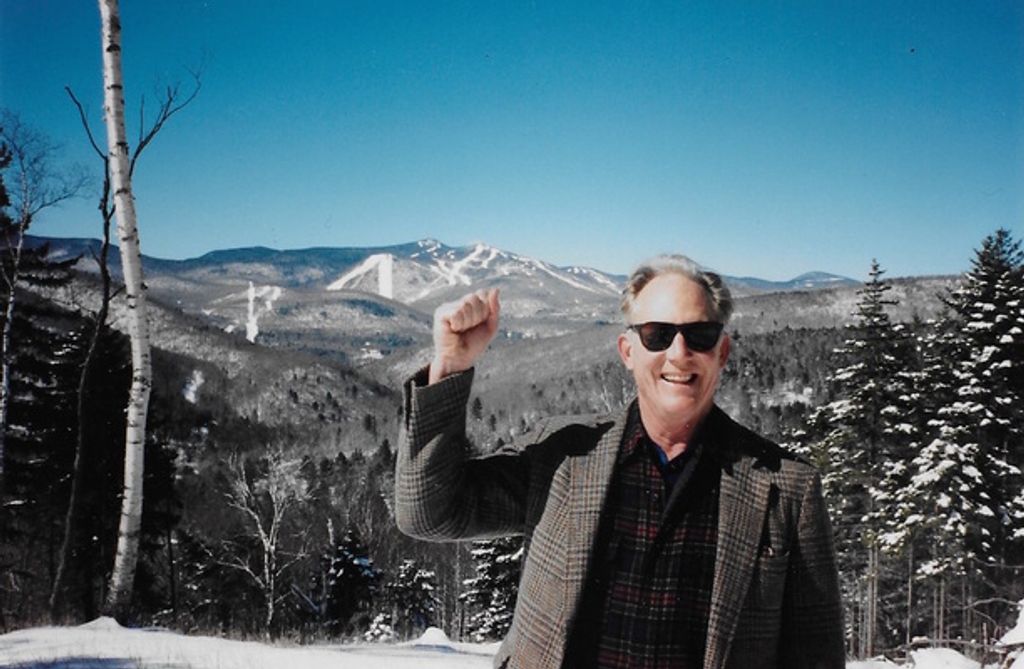
Standish
Sep 3, 1940 — May 26, 2020
Thomas Key Standish's Obituary
Descendant of Thomas Standish, born 1635, Wethersfield, CT and Francis Scott Key (1779-1843), Thomas Key Standish, 79, was the eldest son of Aina Eleanor Oberg of Middletown, CT and Paul Dinsmore Standish of Hartford and Wethersfield, CT. A native of Wethersfield, CT, and a resident of Vermont since the early 1990s, he passed away peacefully from natural causes surrounded by family at home in Bridgewater, VT after a courageous twenty-year battle with Parkinson ' s Disease. A private memorial service will be held later this summer. Memorial donations may be made to The Parkinson ' s Foundation (parkinson.org).
Thomas (Tom) K. Standish was a Renaissance Man whose natural intellect, curiosity, and " quest for the real " led him to extensive international travels, entrepreneurial endeavors, and a life of public and philanthropic service. Tom Standish was an economist, public utilities commissioner, business executive, entrepreneur, restauranteur, real estate developer in Hartford, CT (1979-1992) and Philadelphia, PA (1999-2004), Vermont Town Lister (1998-2018), and Massachusetts Housing Authority Commissioner (2011-2018). Standish was an expert skier and tennis player, high-altitude climber, adventurer, gardener, arts and architecture aficionado, lover of Latin America, and loving father. He became fluent in Spanish and semi-fluent in Portuguese through immersion during a year spent at Mexico City College and a college summer internship in Rio De Janeiro, Brazil.
" In some ways, I ' ve always been regarded as a maverick, " he told the Connecticut Business Journal in 1983, " ...but I see myself as an entrepreneur, as someone who is on the frontier, trying to think of new ways to revitalize [things]...There is nothing that I ' ve set out to do that I haven 't done."
Tom Standish dedicated his professional life in its many guises to making policy and practice in business and government more equitable, especially for the disadvantaged and disenfranchised.
Although a native of Connecticut, with roots in Wethersfield dating back to the early 17th century, Standish loved Vermont, which he regarded as his true home. His attachment was formed by his ancestral ties to Bridgewater, VT and deepened over the years. He started going to Vermont as a child to visit his paternal grandmother ' s relatives in Bridgewater Center and Daley Hollow, where his grandmother Martha Perkins was born and raised. He visited central Vermont for family summer holidays at his uncle Myles Standish ' s house on Old Bridgewater Hill Road. He was taught how to ski by his father and, by age 10, was an advanced skier and, with his younger sister Phoebe, became part of the Mad River Glen Ski Club. He was a 1958 graduate of Wethersfield High School, Wethersfield, CT.
Standish attended the University of Connecticut, Storrs, CT, and received a B.A. in Economics in 1962. He studied at Mexico City College in 1960 and subsequently traveled regularly in Mexico and became a collector of Pre-Columbian art. After a two-year hiatus, he completed a M.A. in Economics in 1966. Standish then attended the Ph.D. program in General Economics at the Wharton School, University of Pennsylvania, in 1966-1967, and the Ph.D. Program in Economics at The New School for Social Research, New York, NY, from 1967 to 1969, where he studied with the eminent German sociologist and economist Adolf Lowe, and received a M.Phil. degree, with distinction.
Standish served on the faculty of Bennington College, Bennington, VT from 1969 to 1972, where he was appointed an assistant professor of economics, with areas of specialization in Marxist theory and Latin American development. In 1969, he had a daughter, Alexandra, with his wife Shirley Ariker.
Standish left Bennington in 1972 to teach economics at the Barney School of Business, University of Hartford, while he also entered public service. He served as Special Economic Consultant, first to the Office of the Corporation Counsel, City of Hartford (1972-1975) during the OPEC oil crisis (1973-74), then to the administration of Connecticut Governor Ella T. Grasso (1974-1979), and then to the Connecticut Public Utilities Commission (1975). He served on the Public Utilities Control Authority from 1975 to 1979.
While at the Office of the Corporation Counsel for the City of Hartford, Standish researched and prepared pro-consumer policy recommendations and reports on all public utility matters and represented the City of Hartford in utility cases brought before the Connecticut Public Utilities Commission and the State Appeals Court. He authored a study on the socio-economic effects of existing school district lines on economic development in the Hartford region, which became the foundation for an Amicus Brief he wrote for the U.S. Supreme Court in Hartford ' s desegregation case, which was combined with the Bradley case in Detroit. He created a strategy, researched other Supreme Court desegregation cases, and integrated results from a prior economic study to create the Brief in just eight days.
In 1975, Standish prepared the Connecticut Public Utilities Development Act for Governor Ella Grasso. This bill proposed a new and creative mechanism for financing utility expansion in Connecticut. The U.S. Department of Energy invited him to participate as one of nine national experts on public utility finance in a special in-house conference to explore methods of finance to solve the then-current capital crisis in the electric utility industry. The White House subsequently used Standish ' s research in developing Wage/Price Guidelines for public utilities, and the U.S. Senate Committee on Commerce invited him to give expert testimony on the use of economic theory for determining electric utility rate structure, in the aftermath of the OPEC Oil Crisis. At this same time, Standish also founded Harconn Associates, Inc., a firm that designed a computer system known as DAIOS for economic planning and industrial development in the greater Hartford area.
After he left the Grasso Administration, Standish applied his expertise in economic development and finance to the private sector as the founder and President of Standish American Capital (initially called the Hartford Development Corp.) from 1979 to 1995 and as owner and CEO of Unitech Corporation of America, Inc., from 1990 to 1996.
At Standish American Capital, he pursued a radical, new approach to urban renewal projects as a private real estate developer. With his two initial partners, Karl Stirner and Janet W. Tanner, Standish purchased vacant land from the city and a burned-out factory building in 1980 in the economically depressed Shelton-Charter Oak neighborhood of downtown Hartford, CT. Once renovations began, Standish resisted political pressures to hire union workers and refused to vie for public monies to fund his master plan for that area of downtown he called Hartford Square. Instead, Standish worked directly with the downtown community, hiring a majority of his construction workers with little or no prior experience from the neighborhood and the city ' s Portguese community. He also was the only Hartford business to hire minority individuals from the Hartford Detention Facility of the state ' s Department of Corrections. " It occurred to me that if we formed our own general contracting company, our own construction company, [and] if we did most of the design ourselves, " Standish told Intercorp business magazine in 1986, " then we could short-circuit a lot of the soft costs [and] eliminat[e] the normal antagonism between [the parties]...and come in 40% less than comparable developments. "
For Hartford Square, a multi-building office complex of over 620,000 square feet, Standish conceived a new financial model of " vertical integration " of real estate functions by creating the architectural design and acting as developer, general contractor, and owner. He then persuaded senior executives of the most prestigious law firms, corporations, and insurance companies to locate in the complex at a time when Hartford was the " insurance capital " of America. Standish earned the Community Development Award in 1985 from the American Institute of Architects/CSA Chapter for his work at Hartford Square. " It ' s a challenge every day. If it were easy, everybody would be doing it, wouldn ' t they? " he told the press at the time.
That was the mantra of Standish ' s life -- the proverbial road-less-traveled -- to take risks and take on new challenges. In 1963, after completing his undergraduate degree at UConn, he and a fraternity brother (who would become his brother-in-law) Jack Giguere, both avid skiers, with Eagle Scout-level survival skills, decided to develop central Vermont ' s first nightclub when the Killington ski resort was just five years old. As Standish ' s paternal grandmother was from Bridgewater, VT and Giguere was from St. Johnsbury, both had Vermont roots and an entrepreneurial bent. Together, they purchased an old homestead on the access road of Killington, and then purchased and relocated ten barns from across New England to construct a three-story restaurant and nightclub irreverently called The Wobbly Barn, now an iconic structure and Killington landmark. Two years after constructing and running the Wobbly Barn, Standish went back to Hartford and Giguere continued to operate the Wobbly Barn and then Charity ' s 1887 Saloon and restaurant.
Some twenty years later, in 1983, as President of Standish American Capital, Standish launched another restaurant (this time, with no nightclub) in downtown Hartford 's " decaying " Charter Oak neighborhood. Built on the site of an abandoned car wash, L 'Am é ricain was one of the first French nouvelle cuisine restaurants of its time and dubbed Hartford 's " most dazzling " restaurant by The New York Times. Designed to lure both prospective corporate tenants to Hartford Square ' s massive office space then under construction and suburbanites to the city after dark, L 'Am é ricain quickly became renowned as a unique dining experience. Its eclectic environment was decorated with both antiques and modern art from Standish ' s own collection and Chef Chris Pardue created signature seasonal menus, a new concept in the restaurant industry then. By the time it closed in 1992, L 'Am é ricain acquired the distinction of being the most expensive restaurant in Connecticut where guests were treated " like kings and queens. "
While Standish was a prominent developer in Hartford during the 1980s and early 1990s, he continued his public service as a member of many non-profit Boards of Directors, including at the University of Hartford, the Hartford Art School, the Wadsworth Atheneum, the Hartford Correctional Facility, and the Connecticut Opera Association.
High risk/high reward was Standish ' s strategy in business as well as in his non-profit Board leadership style. As President of the Connecticut Opera Association, where he served on the Board from 1981 to 1996, Standish successfully championed the first-ever performance in Hartford of world-renowned tenor Luciano Pavarotti in the mid-1990s. An art and antiques collector, Standish was passionate about art and served on both Hartford ' s Wadsworth Atheneum Board of Electors from 1985 to 1994 and The Hartford Art School ' s Board of Trustees from 1987 to 2006. The independent art school had merged with the University of Hartford in the 1960s but by the early 1990s its $10 million endowment was in peril. The Board, led in turns by Georgette Koopman, Helen Krieble (Fuscas), and Standish, successfully waged a protracted legal effort to rescue and protect the Art School ' s endowment from absorption by the University.
While President of the Hartford Art School Board, Standish proposed creating bold new programming to boost the school ' s reputation and rankings. His most notable achievement was the International Distinguished Artists Symposium and Exhibition, which launched in 1994 with a " Beatles ' Reunion " of blue-chip artists Anthony Caro, Kenneth Noland, and Jules Olitski, all of whom had taught at Bennington College together in the 1960s, just before Standish ' s time there on the faculty. Even during the protracted legal dispute between the Hartford Art School and the University of Hartford, Standish also served as a Regent of the University of Hartford from 1991 to 1997. In 2002, he received the Art School ' s highest honor of its Metal of Achievement upon his retirement as Board President.
While Standish maintained ties to Hartford during the 1990s, he had become a resident of Vermont in the early 1990s. He had purchased his first piece of land in Bridgewater at the age of 21 with a small inheritance on the same road as his uncle Myles ' property. He continued to buy land over the years on Bridgewater Hill, overlooking Killington, in order to preserve, rather than develop, it. Above all, he was passionate about the preservation of the rural character of Vermont and the way of life of native Vermonters. He built a post-and-beam barn in four months in 1996 with just one other person.
From 1998 to 2018, Standish served as head of the Board of Listers for the Town of Bridgewater, VT. His unique combination of expertise in finance, statistics, building construction, and law made him an ideal leader to undertake an long-overdue restructuring of the town ' s property tax assessments to make them more equitable. Although not a native Vermonter, Standish parlayed his ancestral roots in Bridgewater and his superior negotiating skills to guide the Town through a peaceable transition to a new model of assessment based on data, not on who you knew in local government. He also defended the Town pro-se in several million-dollar tax appeals and grievances.
Standish ' s most notable achievement during his tenure as a Lister was the " Stonegate " case in 2000 against Jim Manzi, the former CEO of Lotus Development, and his wife Glenda, who had built a 13,000 square foot home on 460 acres with majestic mountain-top views. The protracted two-year-long, precedent-setting appeal case landed the Town of Bridgewater an article in The New York Times. As Standish told The Times, ''In the last five years or so, Vermont has become like the coast of Maine was -- the superrich are starting to discover it, and we are seeing that happen here...We're the first to confront the fact that very high-end properties are scarce as hen's teeth.''
With Standish serving as pro-se counsel for the Town at the state appeals level, he defended the Town ' s $6 million assessment against the Manzi ' s $2 million claim. He attacked what he dubbed the " Martha Stewart Defense " of wealthy second-home owners who claimed their properties were too idiosyncratic to resell at their actual building cost. Instead, Standish asserted that luxurious architectural and interior design features did not make a home too eccentric or unique to sell at cost, well above the Fair Market Value in Vermont at the time. ''The argument that the rich don't know what they're doing with their money, and will build toys they'll never get their money back out of is not a credible one, in our opinion,'' Standish told The Times in September 2000.
The Town prevailed at a moment when Bridgewater desperately needed the additional property tax revenue to fund its then-flagging (now closed) primary school and to resist the first case in Vermont of a national trend of gentrification occurring in other vacation destinations.
His marriage to art historian, curator, and museum director Amy I. Schlegel in 1999 led him to Philadelphia and then Boston. In 2011, Standish was tapped to be the Chairman of the beleaguered Chelsea Housing Authority Board in the working class, Latino-dominated small city of Chelsea, MA, just two miles from Boston, where he and his wife and their son resided from 2006 to 2018. The large Housing Authority system was in disarray and embroiled in scandal after the decades-long corruption, fraud, and extortion practices by its disgraced executive director were exposed. Standish led the successful Board effort, with pro bono legal counsel, to prosecute and sentence the corrupt director and recoup funds paid both to him and to the U.S. Department of Housing and Urban Development. " It has been invigorating and exciting [to see public housing work in Chelsea]. I regard it as a gift to have had the opportunity, " he told the Chelsea Record upon his retirement from the Board in 2018.
Thomas Key Standish is survived by his wife of 20 years, Amy Ingrid Schlegel of Acton, MA, sister Phoebe Dinsmore Standish of Woodstock, VT, brother Leigh Harrison Standish of Wethersfield, CT, children Alexandra Ariker Standish of Saugerties, NY and Thomas W.P. Standish of Acton, MA, grandchildren Sophia Ruth Goode and Lena Eleanor Goode, son-in-law Jonathan Daniel Goode of Saugerties, NY, niece Melissa Standish, nephews Jared Standish and Brett Standish Giguere, great nephew Colin Giguere, sisters-in-law Betty Standish and Libby Standish, and brother-in-law David J. Schlegel. He was the uncle of the late R. Scott Giguere of Killington, VT and the half-brother of the late John Standish of Cos Cob, CT.
Thomas Key Standish's Guestbook

Visits: 65
This site is protected by reCAPTCHA and the
Google Privacy Policy and Terms of Service apply.
Service map data © OpenStreetMap contributors